Social media optimization (SMO) is the use of online platforms to generate income or publicity to increase the awareness of a brand, event, product or service. Types of social media involved include RSS feeds, blogging sites, social bookmarking sites, social news websites, video sharing websites such as YouTube and social networking sites such as Facebook, Instagram, TikTok and X (Twitter). SMO is similar to search engine optimization (SEO) in that the goal is to drive web traffic, and draw attention to a company or creator. SMO's focal point is on gaining organic links to social media content. In contrast, SEO's core is about reaching the top of the search engine hierarchy. In general, social media optimization refers to optimizing a website and its content to encourage more users to use and share links to the website across social media and networking sites. SMO is used to strategically create online content ranging from well-written text to eye-catching digital photos or video clips that encourages and entices people to engage with a website. Users share this content, via its weblink, with social media contacts and friends. Common examples of social media engagement are "liking and commenting on posts, retweeting, embedding, sharing, and promoting content". Social media optimization is also an effective way of implementing online reputation management (ORM), meaning that if someone posts bad reviews of a business, an SMO strategy can ensure that the negative feedback is not the first link to come up in a list of search engine results. In the 2010s, with social media sites overtaking TV as a source for news for young people, news organizations have become increasingly reliant on social media platforms for generating web traffic. Publishers such as The Economist employ large social media teams to optimize their online posts and maximize traffic, while other major publishers now use advanced artificial intelligence (AI) technology to generate higher volumes of web traffic. == Relationship with search engine optimization == Social media optimization is an increasingly important factor in search engine optimization, which is the process of designing a website in a way so that it has as high a ranking as possible on search engines. Search engines are increasingly utilizing the recommendations of users of social networks such as Reddit, Facebook, Tumblr, Twitter, YouTube, LinkedIn, Pinterest and Instagram to rank pages in the search engine result pages. The implication is that when a webpage is shared or "liked" by a user on a social network, it counts as a "vote" for that webpage's quality. Thus, search engines can use such votes accordingly to properly ranked websites in search engine results pages. Furthermore, since it is more difficult to tip the scales or influence the search engines in this way, search engines are putting more stock into social search. This, coupled with increasingly personalized search based on interests and location, has significantly increased the importance of a social media presence in search engine optimization. Due to personalized search results, location-based social media presences on websites such as Yelp, Google Places, Foursquare, and Yahoo! Local have become increasingly important. While social media optimization is related to search engine marketing, it differs in several ways. Primarily, SMO focuses on driving web traffic from sources other than search engines, though improved search engine ranking is also a benefit of successful social media optimization. Further, SMO is helpful to target particular geographic regions in order to target and reach potential customers. This helps in lead generation (finding new customers) and contributes to high conversion rates (i.e., converting previously uninterested individuals into people who are interested in a brand or organization). == Relationship with viral marketing == Social media optimization is in many ways connected to the technique of viral marketing or "viral seeding" where word of mouth is created through the use of networking in social bookmarking, video and photo sharing websites. An effective SMO campaign can harness the power of viral marketing; for example, 80% of activity on Pinterest is generated through "repinning." Furthermore, by following social trends and utilizing alternative social networks, websites can retain existing followers while also attracting new ones. This allows businesses to build an online following and presence, all linking back to the company's website for increased traffic. For example, with an effective social bookmarking campaign, not only can website traffic be increased, but a site's rankings can also be increased. In a similar way, the engagement with blogs creates a similar result by sharing content through the use of RSS in the blogosphere. Social media optimization is considered an integral part of an online reputation management (ORM) or search engine reputation management (SERM) strategy for organizations or individuals who care about their online presence. SMO is one of six key influencers that affect Social Commerce Construct (SCC). Online activities such as consumers' evaluations and advices on products and services constitute part of what creates a Social Commerce Construct (SCC). Social media optimization is not limited to marketing and brand building. Increasingly, smart businesses are integrating social media participation as part of their knowledge management strategy (i.e., product/service development, recruiting, employee engagement and turnover, brand building, customer satisfaction and relations, business development and more). Additionally, social media optimization can be implemented to foster a community of the associated site, allowing for a healthy business-to-consumer (B2C) relationship. == Origins and implementation == According to technologist Danny Sullivan, the term "social media optimization" was first used and described by marketer Rohit Bhargava on his marketing blog in August 2006. In the same post, Bhargava established the five important rules of social media optimization. Bhargava believed that by following his rules, anyone could influence the levels of traffic and engagement on their site, increase popularity, and ensure that it ranks highly in search engine results. An additional 11 SMO rules have since been added to the list by other marketing contributors. The 16 rules of SMO, according to one source, are as follows: Increase your linkability Make tagging and bookmarking easy Reward inbound links Help your content to "travel" via sharing Encourage the mashup, where users are allowed to remix content Be a user resource, even if it doesn't help you (e.g., provide resources and information for users) Reward helpful and valuable users Participate (join the online conversation) Know how to target your audience Create new, quality content ("web scraping" of existing online content is ignored by good search engines) Be "real" in the tone and style of the posts Don't forget your roots; be humble Don't be afraid to experiment, innovate, try new things and "stay fresh" Develop an SMO strategy Choose your SMO tactics wisely Make SMO a key part of your marketing process and develop company best practices Bhargava's initial five rules were more specifically designed to SMO, while the list is now much broader and addresses everything that can be done across different social media platforms. According to author and CEO of TopRank Online Marketing, Lee Odden, a Social Media Strategy is also necessary to ensure optimization. This is a similar concept to Bhargava's list of rules for SMO. The Social Media Strategy may consider: Objectives e.g. creating brand awareness and using social media for external communications. Listening e.g. monitoring conversations relating to customers and business objectives. Audience e.g. finding out who the customers are, what they do, who they are influenced by, and what they frequently talk about. It is important to work out what customers want in exchange for their online engagement and attention. Participation and content e.g. establishing a presence and community online and engaging with users by sharing useful and interesting information. Measurement e.g. keeping a record of likes and comments on posts, and the number of sales to monitor growth and determine which tactics are most useful in optimizing social media. According to Lon Safko and David K. Brake in The Social Media Bible, it is also important to act like a publisher by maintaining an effective organizational strategy, to have an original concept and unique "edge" that differentiates one's approach from competitors, and to experiment with new ideas if things do not work the first time. If a business is blog-based, an effective method of SMO is using widgets that allow users to share content to their personal social media platforms. This will ultimately reach a wider target audience and drive mor
Exposure Notification
The (Google/Apple) Exposure Notification System (GAEN) is a framework and protocol specification developed by Apple Inc. and Google to facilitate digital contact tracing during the COVID-19 pandemic. When used by health authorities, it augments more traditional contact tracing techniques by automatically logging close approaches among notification system users using Android or iOS smartphones. Exposure Notification is a decentralized reporting protocol built on a combination of Bluetooth Low Energy technology and privacy-preserving cryptography. It is an opt-in feature within COVID-19 apps developed and published by authorized health authorities. Unveiled on April 10, 2020, it was made available on iOS on May 20, 2020, as part of the iOS 13.5 update and on December 14, 2020, as part of the iOS 12.5 update for older iPhones. On Android, it was added to devices via a Google Play Services update, supporting all versions since Android Marshmallow. The Apple/Google protocol is similar to the Decentralized Privacy-Preserving Proximity Tracing (DP-3T) protocol created by the European DP-3T consortium and the Temporary Contact Number (TCN) protocol by Covid Watch, but is implemented at the operating system level, which allows for more efficient operation as a background process. Since May 2020, a variant of the DP-3T protocol is supported by the Exposure Notification Interface. Other protocols are constrained in operation because they are not privileged over normal apps. This leads to issues, particularly on iOS devices where digital contact tracing apps running in the background experience significantly degraded performance. The joint approach is also designed to maintain interoperability between Android and iOS devices, which constitute nearly all of the market. The ACLU stated the approach "appears to mitigate the worst privacy and centralization risks, but there is still room for improvement". In late April, Google and Apple shifted the emphasis of the naming of the system, describing it as an "exposure notification service", rather than "contact tracing" system. == Technical specification == Digital contact tracing protocols typically have two major responsibilities: encounter logging and infection reporting. Exposure Notification only involves encounter logging which is a decentralized architecture. The majority of infection reporting is centralized in individual app implementations. To handle encounter logging, the system uses Bluetooth Low Energy to send tracking messages to nearby devices running the protocol to discover encounters with other people. The tracking messages contain unique identifiers that are encrypted with a secret daily key held by the sending device. These identifiers change every 15–20 minutes as well as Bluetooth MAC address in order to prevent tracking of clients by malicious third parties through observing static identifiers over time. The sender's daily encryption keys are generated using a random number generator. Devices record received messages, retaining them locally for 14 days. If a user tests positive for infection, the last 14 days of their daily encryption keys can be uploaded to a central server, where it is then broadcast to all devices on the network. The method through which daily encryption keys are transmitted to the central server and broadcast is defined by individual app developers. The Google-developed reference implementation calls for a health official to request a one-time verification code (VC) from a verification server, which the user enters into the encounter logging app. This causes the app to obtain a cryptographically signed certificate, which is used to authorize the submission of keys to the central reporting server. The received keys are then provided to the protocol, where each client individually searches for matches in their local encounter history. If a match meeting certain risk parameters is found, the app notifies the user of potential exposure to the infection. Google and Apple intend to use the received signal strength (RSSI) of the beacon messages as a source to infer proximity. RSSI and other signal metadata will also be encrypted to resist deanonymization attacks. === Version 1.0 === To generate encounter identifiers, first a persistent 32-byte private Tracing Key ( t k {\displaystyle tk} ) is generated by a client. From this a 16 byte Daily Tracing Key is derived using the algorithm d t k i = H K D F ( t k , N U L L , 'CT-DTK' | | D i , 16 ) {\displaystyle dtk_{i}=HKDF(tk,NULL,{\text{'CT-DTK'}}||D_{i},16)} , where H K D F ( Key, Salt, Data, OutputLength ) {\displaystyle HKDF({\text{Key, Salt, Data, OutputLength}})} is a HKDF function using SHA-256, and D i {\displaystyle D_{i}} is the day number for the 24-hour window the broadcast is in starting from Unix Epoch Time. These generated keys are later sent to the central reporting server should a user become infected. From the daily tracing key a 16-byte temporary Rolling Proximity Identifier is generated every 10 minutes with the algorithm R P I i , j = Truncate ( H M A C ( d t k i , 'CT-RPI' | | T I N j ) , 16 ) {\displaystyle RPI_{i,j}={\text{Truncate}}(HMAC(dtk_{i},{\text{'CT-RPI'}}||TIN_{j}),16)} , where H M A C ( Key, Data ) {\displaystyle HMAC({\text{Key, Data}})} is a HMAC function using SHA-256, and T I N j {\displaystyle TIN_{j}} is the time interval number, representing a unique index for every 10 minute period in a 24-hour day. The Truncate function returns the first 16 bytes of the HMAC value. When two clients come within proximity of each other they exchange and locally store the current R P I i , j {\displaystyle RPI_{i,j}} as the encounter identifier. Once a registered health authority has confirmed the infection of a user, the user's Daily Tracing Key for the past 14 days is uploaded to the central reporting server. Clients then download this report and individually recalculate every Rolling Proximity Identifier used in the report period, matching it against the user's local encounter log. If a matching entry is found, then contact has been established and the app presents a notification to the user warning them of potential infection. === Version 1.1 === Unlike version 1.0 of the protocol, version 1.1 does not use a persistent tracing key, rather every day a new random 16-byte Temporary Exposure Key ( t e k i {\displaystyle tek_{i}} ) is generated. This is analogous to the daily tracing key from version 1.0. Here i {\displaystyle i} denotes the time is discretized in 10 minute intervals starting from Unix Epoch Time. From this two 128-bit keys are calculated, the Rolling Proximity Identifier Key ( R P I K i {\displaystyle RPIK_{i}} ) and the Associated Encrypted Metadata Key ( A E M K i {\displaystyle AEMK_{i}} ). R P I K i {\displaystyle RPIK_{i}} is calculated with the algorithm R P I K i = H K D F ( t e k i , N U L L , 'EN-RPIK' , 16 ) {\displaystyle RPIK_{i}=HKDF(tek_{i},NULL,{\text{'EN-RPIK'}},16)} , and A E M K i {\displaystyle AEMK_{i}} using the algorithm A E M K i = H K D F ( t e k i , N U L L , 'EN-AEMK' , 16 ) {\displaystyle AEMK_{i}=HKDF(tek_{i},NULL,{\text{'EN-AEMK'}},16)} . From these values a temporary Rolling Proximity Identifier ( R P I i , j {\displaystyle RPI_{i,j}} ) is generated every time the BLE MAC address changes, roughly every 15–20 minutes. The following algorithm is used: R P I i , j = A E S 128 ( R P I K i , 'EN-RPI' | | 0 x 000000000000 | | E N I N j ) {\displaystyle RPI_{i,j}=AES128(RPIK_{i},{\text{'EN-RPI'}}||{\mathtt {0x000000000000}}||ENIN_{j})} , where A E S 128 ( Key, Data ) {\displaystyle AES128({\text{Key, Data}})} is an AES cryptography function with a 128-bit key, the data is one 16-byte block, j {\displaystyle j} denotes the Unix Epoch Time at the moment the roll occurs, and E N I N j {\displaystyle ENIN_{j}} is the corresponding 10-minute interval number. Next, additional Associated Encrypted Metadata is encrypted. What the metadata represents is not specified, likely to allow the later expansion of the protocol. The following algorithm is used: Associated Encrypted Metadata i , j = A E S 128 _ C T R ( A E M K i , R P I i , j , Metadata ) {\displaystyle {\text{Associated Encrypted Metadata}}_{i,j}=AES128\_CTR(AEMK_{i},RPI_{i,j},{\text{Metadata}})} , where A E S 128 _ C T R ( Key, IV, Data ) {\displaystyle AES128\_CTR({\text{Key, IV, Data}})} denotes AES encryption with a 128-bit key in CTR mode. The Rolling Proximity Identifier and the Associated Encrypted Metadata are then combined and broadcast using BLE. Clients exchange and log these payloads. Once a registered health authority has confirmed the infection of a user, the user's Temporary Exposure Keys t e k i {\displaystyle tek_{i}} and their respective interval numbers i {\displaystyle i} for the past 14 days are uploaded to the central reporting server. Clients then download this report and individually recalculate every Rolling Proximity Identifier starting from interval number i {\displaystyle i} ,
Shorty Awards
The Shorty Awards (also known as "The Shortys") are awards for outstanding and innovative work in digital and social media content by brands, advertising agencies, and creators. The awards, which generally focus on short-term content, honor achievements in content creation on Twitter, Facebook, YouTube, Instagram, TikTok, Twitch, and other social networking sites. The Shorty Awards began in 2008 and initially recognized achievements by independent creators on Twitter, with the first formal awards ceremony occurring in February 2009. Since then, the awards, which are now awarded each spring, have shifted their focus to recognize content across numerous platforms. Entrant work is judged on the merits of excellence in creativity, strategy, and engagement by the Real Time Academy, a group of industry professionals selected by the Shorty Awards on the basis of their professional reputations, industry knowledge, and personal achievements (which may include previous Shorty wins). An additional public voting component, known as Audience Honor Voting, is also used to select Shorty Awards contenders. Notable Shorty Award winners include Malala Yousafzai, Trevor Noah, Michelle Obama, Conan O’Brien, Lady Gaga, Bill Nye, Jacob Reed, and Lizzo. Brands and organizations such as Chipotle, Duolingo, Marvel Studios, HBO, Red Bull, Airbnb, Nestle, BMW, UNICEF and the Human Rights Campaign have also been awarded. The Shorty Awards also produces an annual award program called The Shorty Impact Awards, a competition dedicated to showcasing digital and social media-based projects by brands, agencies, and organizations that seek to make the world a better place. == List of ceremonies == == 1st Shorty Awards == The awards were created in 2008 by tech entrepreneurs Greg Galant, Adam Varga, and Lee Semel of Sawhorse Media. They invited Twitter account holders to nominate the best Twitter users in general categories such as humor, news, food, and design. Winners were chosen by more than 30,000 Twitter users during the voting period. The founders of Twitter first heard about the awards after the contest had gotten underway and expressed support for it. The first Shorty Awards ceremony was held on February 11, 2009, at the Galapagos Art Space in Brooklyn, New York. Approximately 300 people attended the event. The event was hosted by CNN anchor Rick Sanchez and featured appearances by prominent Twitter users MC Hammer and Gary Vaynerchuk and a video appearance by Shaquille O'Neal. The awards, in 26 categories, were voted on by Twitter users. == 2nd Shorty Awards == Voting for the second Shorty Awards opened in January 2010 in 26 official categories. A Real-Time Photo of the Year category was added to the list of official categories for the first time, recognizing the best photo posted to services such as Twitpic, Yfrog, or Facebook. The second Shorty Awards competition introduced a panel of judges called the Real-Time Academy of Short Form Arts & Sciences whose members were Craig Newmark, David Pogue, Kurt Andersen, Caterina Fake, Joi Ito, Frank Moss, Alberto Ibargüen, Sreenath Sreenivasan, MC Hammer, Alyssa Milano and Jimmy Wales. After public nominations determined the finalists, the academy decided on the winners. Winners were announced at a ceremony held in the Times Center in The New York Times building in Manhattan that was also streamed online. The ceremony was hosted by CNN anchor Rick Sanchez, who presented awards in the official categories as well as the newly added Real-Time Photo of the Year and a special humanitarian award. == 3rd Shorty Awards == The nomination period for the third annual Shorty Awards opened in January 2011 and ran through February 11, 2011, except for new categories that had extended nomination deadlines. There were 30 official categories and five special categories. In addition to Real-Time Photo of the Year, for the first time the awards accepted nominations for Foursquare Mayor of the Year, Foursquare Location of the Year, Microblog of the Year on Tumblr, and a Connecting People award. The awards also introduced new Shorty Industry Awards to recognize the best uses of social media by brands and agencies. Winners were announced at a ceremony on March 28, 2011, hosted by Aasif Mandvi in the Times Center. Other Shorty Awards presenters were scheduled to include Kiefer Sutherland, Jerry Stiller, Anne Meara, Stephen Wallem, Miss USA Rima Fakih, and Miss Teen USA Kamie Crawford. == 4th Shorty Awards == The 4th Annual Shorty Awards featured Ricky Gervais and Tiffani Thiessen. 1.6 million tweeted nominations were made across all the categories to honor the top users on Twitter, Facebook, Tumblr, Foursquare, YouTube and other internet platforms. == 5th Shorty Awards == The 5th Annual Shorty Awards ceremony featured Felicia Day, James Urbaniak, Kristian Nairn, Hannibal Buress, Carrie Keagan, Chris Hardwick, David Karp and Coco Rocha. 2.4 million tweeted nominations were made across all the categories to honor the top users on Twitter, Facebook, Tumblr, Foursquare, YouTube and other internet sites. == 6th Shorty Awards == The ceremony took place on April 7, 2014, at the New York TimesCenter and was hosted by Comedian Natasha Leggero. The show included appearances by Patton Oswalt, Jamie Oliver, Kristen Bell, Jerry Seinfeld, Moshe Kasher, Julie Klausner, Erin Brady, Guy Kawasaki, Matt Walsh, Retta, Us the Duo, Big Boi, Gilbert Gottfried, Thomas Middleditch, Billie Jean King and Leandra Medine. Winners included Jerry Seinfeld and Will Ferrell. == 7th Shorty Awards == The Seventh Annual Shorty Awards was hosted by comedian Rachel Dratch and took place on April 20, 2015, at The Times Center in NYC. The Real-Time Academy, the judging body of the Shortys, tripled in size for the 7th annual Awards and included Alton Brown, Mamrie Hart, Nikki Glaser, OK Go, The Fine Bros, Debbie Sterling, Dan Savage, Deena Varshavskaya and Palmer Luckey. Panic! at the Disco was the musical guest at the ceremony. On-stage presenters included Kevin Jonas, Bill Nye, Bella Thorne, Wyclef Jean, Emily Kinney and Tyler Oakley. == 8th Shorty Awards == The Eighth Annual Shorty Awards were held in NYC at the TimesCenter on April 11, 2016. They were hosted by YouTuber, Writer and Comedian Mamrie Hart with musical performances from Nico & Vinz. Winners of the night included Bill Wurtz, DJ Khaled, Misty Copeland, Casey Neistat, Dwayne Johnson, Hannah Hart, Troye Sivan, Baddie Winkle, Kevin Hart, Taraji P. Henson, King Bach, and Zach King. == 9th Shorty Awards == The Ninth Annual Shorty Awards were held in NYC at the PlayStation Theater on April 23, 2017. They were hosted by two-time Emmy Award winner Tony Hale with a musical performance by Lizzo. Winners of the night included Bill Nye, Shay Mitchell, Doug the Pug, Gigi Gorgeous, Simone Biles, Mara Wilson, Gaten Matarazzo and Chrissy Teigen. == 10th Shorty Awards == The 10th Annual Shorty Awards, took place on April 15, 2018, at the PlayStation Theater, New York City. The ceremony was hosted by actress, singer, and songwriter Keke Palmer with a musical performance by Betty Who. == 11th Shorty Awards == The 11th Annual Shorty Awards were held on May 5, 2019, in New York City at the PlayStation Theater. The ceremony was hosted by American actress and comedian Kathy Griffin, with a musical performance by Tank and the Bangas. == 12th Shorty Awards == The 12th Annual Shorty Awards were held on May 3, 2020. Due to the COVID-19 pandemic, the ceremony took place online for the first time, with presenters and award winners filming from their own homes. The ceremony was hosted by actor J.B. Smoove and featured a remixed performance of Trap Queen by Fetty Wap. Award winners included Jack Stauber, Supercar Blondie, Rose and Rosie, and Greta Thunberg. == 13th Shorty Awards == The 13th Annual Shorty Awards took place from April 26 to May 14, 2021. The ceremony was hosted on different social media platforms, such as Instagram and Clubhouse, to create a more tailored experience. Winners were announced from May 11 to May 14, with 10 winners being revealed each hour from 1 to 4 p.m. EST on the Shorty Awards Instagram account. == 14th Shorty Awards == The 14th Annual Shorty Awards were held virtually on May 15, 2022, honoring the best in social media and digital content. Hosted by Jay Shetty, the event recognized influencers, brands, and organizations across various categories, celebrating excellence in digital storytelling and innovative online campaigns. Notable winners included Tabitha Brown for her food content and the D'Amelio Family for their contributions to family and parenting content. The event highlighted the role of digital media in connecting and inspiring audiences during challenging times. == 15th Shorty Awards == The 15th Annual Shorty Awards celebrated the best in social media and digital content on May 24, 2023, at Tribeca 360° in New York City. Hosted by Jay Pharoah, the event honored creators, brands, and organizations ac
Content engineering
Content engineering is a term applied to an engineering specialty dealing with the complexities around the use of content in computer-facilitated environments. Content authoring and production, content management, content modeling, content conversion, and content use and repurposing are all areas involving this practice. It is not a specialty with wide industry recognition and is often performed on an ad hoc basis by members of software development or content production or marketing staff, but is beginning to be recognized as a necessary function in any complex content-centric project involving both content production as well as software system development mainly involving content management systems (CMS) or digital experience platforms (DXP). Content engineering tends to bridge the gap between groups involved in the production of content (publishing and editorial staff, marketing, sales, human resources) and more technologically oriented departments such as software development, or IT that put this content to use in web or other software-based environments, and requires an understanding of the issues and processes of both sides. Typically, content engineering involves extensive use of embedded XML technologies, XML being the most widespread language for representing structured content. Content management systems are a key technology often used in the practice of content engineering. == Definition == Content engineering is the practice of organizing the shape and structure of content by deploying content and metadata models, in authoring and publishing processes in a manner that meets the requirements of an organization's Content Strategy, and its implementation through the use of technology such as CMS, XML, schema markup, artificial intelligence, APIs and others. == Purpose and goal == In very general terms, content engineering practices aim to maximize the ROI of content through content reuse and improving efficiency of content marketing, content operations, content strategy. Content engineering can help address content challenges that fairly typical organizations face: Siloed content supply chains Duplicate content in a myriad of formats Inefficient content authoring workflows Chunky, unstructured content Outdated technology Technology in place does not match needs Inability to reuse content across channels (multi-channel content) Metadata and schema are not used Lack of standards for metadata Lack of findability of content for internal and external use Poor SEO performance Inability to implement personalization == Key skills == Content engineering draws on a combination of technical, strategic, and editorial competencies. Practitioners typically require proficiency across several domains: === Content modeling and information architecture === Content engineers design structured content models that define how content is created, stored, and distributed. This includes building taxonomies, ontologies, and metadata schemas that enable content reuse across channels and platforms. === Structured content and markup languages === Proficiency in XML, JSON, HTML, and schema.org markup is fundamental. Content engineers use these languages to structure content for machine readability, search engine optimization, and interoperability between systems. === Content management systems and platforms === Content engineers require working knowledge of content management systems (CMS), digital experience platforms (DXP), and headless CMS architectures. This includes configuring content types, workflows, and publishing pipelines within these systems. === Workflow design and automation === Designing and implementing content workflows - from authoring through review, approval, and distribution - is a core function. Increasingly, this involves configuring AI-assisted and agentic workflows that automate research, drafting, repurposing, and distribution tasks at scale. === Content strategy and editorial understanding === Unlike purely technical roles, content engineering requires a working understanding of content strategy, brand management, editorial standards, and audience analysis. Content engineers must translate strategic objectives into technical content structures and system configurations. === API integration and data interoperability === Content engineers work with APIs to connect content systems, analytics platforms, distribution channels, and third-party services. Understanding how content flows between systems is essential for enabling multi-channel publishing and content personalization. === Analytics and performance measurement === Measuring content effectiveness through web analytics, SEO performance data, and engagement metrics informs how content engineers refine structures, metadata, and distribution workflows. == The role of a content engineer == Content engineers bridge the divide between content strategists and producers and the developers and content managers who publish and distribute content. But rather than simply wedging themselves between these players, content engineers help define and facilitate the content structure during the entire content strategy, production and distribution cycle from beginning to end. As the role has evolved, content engineers are increasingly expected to build and manage AI-powered content systems, moving beyond traditional CMS configuration into agentic workflows that automate content research, production, and distribution. By integrating skills in business and technology, content engineers do not see content as static or finished. Rather, they look at the value of the content and how it can best be adapted and personalized to serve customers and emerging content platforms, technologies, and opportunities. === Create customer experience === Content marketing suffers from two fundamental limitations that constrain the true power and potential that a great content marketing plan can bring to a business' bottom line: Content relevance: how to make content more relevant and personalized to their audiences. The marketer and content strategist direct the customer experience itself, and the content engineer makes it happen with content structure, schema, metadata, microdata, taxonomy, and CMS topology. Content agility: Marketers who are burdened with one-size-fits-all content remain stuck managing their content rather than their customers' experience. Content engineers give marketers the "super powers" to move content-powered experiences across interfaces and personalization variants. === Break down barriers === Empower content strategists: Content engineers work with content strategists by helping them connect content not as a fixed message, but as a modular construct which can be channeled and manipulated. Enable content producers: A content engineer will work with a content producer by helping to find new sources of content and ways the content can be combined and presented. Guide and free developers: The content engineer helps translate marketing strategy into clear technical needs and functions developers can build into content management systems Enhance content management: Develop content structures that make it easier for content writers and content managers to author to a single, very usable, interface for even complex content types that might contain dozens of elements. Engineer content for success: Content engineers help all members of a marketing team work more smoothly, with the support and structures needed to get the most out of the content they produce. === Salary benchmarks === Content engineering roles command significantly higher salaries than traditional content marketing positions. In the United States, IC-level content engineers earn between $120,000 and $165,000 annually, while senior roles reach $160,000 to $220,000. Head of content engineering positions range from $200,000 to $280,000, and VP-level roles can exceed $375,000. The emergence of dedicated content engineer job postings from companies such as Exit Five reflects the growing recognition of the role as a distinct function within marketing organizations.
Social media newsroom
A social media newsroom is a company resource, set up to increase the functionality and usability of the traditional online newsroom. Social media newsrooms (SMNs) are intended to encourage dialogue and information sharing. Unlike online newsrooms, content is accessible to more than just journalists, but to all those with whom the company engages such as bloggers, their prospects, customers, business partners and investors. It gives these stakeholders access to news, public relations announcements, images, audio, video and other multimedia files. In addition to posting press releases and corporate news, companies can integrate other social content from sites such as YouTube, Flickr and Slideshow as well as streams from corporate Twitter accounts. Traditional tools for journalists such as corporate fast facts, leadership information, a multimedia library, financial information, awards and other recent media coverage are also included in an SMN. Examples of companies effectively using social media newsrooms include Opel Group, Pressat, First Direct, MyNewsdesk, Scania and Newport Beach.
Outline of robotics
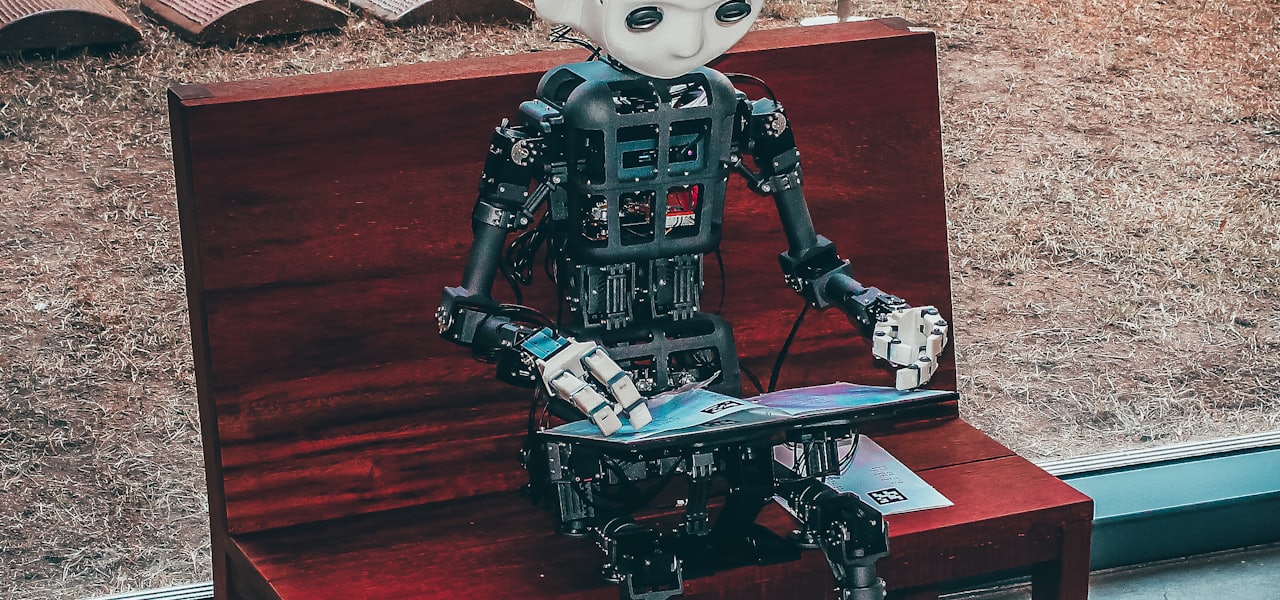
The following outline is provided as an overview of and topical guide to robotics: Robotics is a branch of mechanical engineering, electrical engineering and computer science that deals with the design, construction, operation, and application of robots, as well as computer systems for their control, sensory feedback, and information processing. These technologies deal with automated machines that can take the place of humans in dangerous environments or manufacturing processes, or resemble humans in appearance, behaviour, and or cognition. Many of today's robots are inspired by nature contributing to the field of bio-inspired robotics. The word "robot" was introduced to the public by Czech writer Karel Čapek in his play R.U.R. (Rossum's Universal Robots), published in 1920. The term "robotics" was coined by Isaac Asimov in his 1941 science fiction short-story "Liar!" == Nature of robotics == Robotics can be described as: An applied science – scientific knowledge transferred into a physical environment. A branch of computer science – A branch of electrical engineering – A branch of mechanical engineering – Research and development – A branch of technology – == Branches of robotics == Adaptive control – control method used by a controller which must adapt to a controlled system with parameters which vary, or are initially uncertain. For example, as an aircraft flies, its mass will slowly decrease as a result of fuel consumption; a control law is needed that adapts itself to such changing conditions. Aerial robotics – development of unmanned aerial vehicles (UAVs), commonly known as drones, aircraft without a human pilot aboard. Their flight is controlled either autonomously by onboard computers or by the remote control of a pilot on the ground or in another vehicle. Android science – interdisciplinary framework for studying human interaction and cognition based on the premise that a very humanlike robot (that is, an android) can elicit human-directed social responses in human beings. Anthrobotics – science of developing and studying robots that are either entirely or in some way human-like. Artificial intelligence – the intelligence of machines and the branch of computer science that aims to create it. Artificial neural networks – a mathematical model inspired by biological neural networks. Autonomous car – an autonomous vehicle capable of fulfilling the human transportation capabilities of a traditional car Autonomous research robotics – Bayesian network – BEAM robotics – a style of robotics that primarily uses simple analogue circuits instead of a microprocessor in order to produce an unusually simple design (in comparison to traditional mobile robots) that trades flexibility for robustness and efficiency in performing the task for which it was designed. Behavior-based robotics – the branch of robotics that incorporates modular or behavior based AI (BBAI). Bio-inspired robotics – making robots that are inspired by biological systems. Biomimicry and bio-inspired design are sometimes confused. Biomimicry is copying the nature while bio-inspired design is learning from nature and making a mechanism that is simpler and more effective than the system observed in nature. Biomimetic – see Bionics. Biomorphic robotics – a sub-discipline of robotics focused upon emulating the mechanics, sensor systems, computing structures and methodologies used by animals. Bionics – also known as biomimetics, biognosis, biomimicry, or bionical creativity engineering is the application of biological methods and systems found in nature to the study and design of engineering systems and modern technology. Biorobotics – a study of how to make robots that emulate or simulate living biological organisms mechanically or even chemically. Cloud robotics – is a field of robotics that attempts to invoke cloud technologies such as cloud computing, cloud storage, and other Internet technologies centered around the benefits of converged infrastructure and shared services for robotics. Cognitive robotics – views animal cognition as a starting point for the development of robotic information processing, as opposed to more traditional Artificial Intelligence techniques. Clustering – Computational neuroscience – study of brain function in terms of the information processing properties of the structures that make up the nervous system. Robot control – a study of controlling robots Robotics conventions – Data mining Techniques – Degrees of freedom – in mechanics, the degree of freedom (DOF) of a mechanical system is the number of independent parameters that define its configuration. It is the number of parameters that determine the state of a physical system and is important to the analysis of systems of bodies in mechanical engineering, aeronautical engineering, robotics, and structural engineering. Developmental robotics – a methodology that uses metaphors from neural development and developmental psychology to develop the mind for autonomous robots Digital control – a branch of control theory that uses digital computers to act as system controllers. Digital image processing – the use of computer algorithms to perform image processing on digital images. Dimensionality reduction – the process of reducing the number of random variables under consideration, and can be divided into feature selection and feature extraction. Distributed robotics – Electronic stability control – is a computerized technology that improves the safety of a vehicle's stability by detecting and reducing loss of traction (skidding). Evolutionary computation – Evolutionary robotics – a methodology that uses evolutionary computation to develop controllers for autonomous robots Extended Kalman filter – Flexible Distribution functions – Feedback control and regulation – Human–computer interaction – a study, planning and design of the interaction between people (users) and computers Human robot interaction – a study of interactions between humans and robots Intelligent vehicle technologies – comprise electronic, electromechanical, and electromagnetic devices - usually silicon micromachined components operating in conjunction with computer controlled devices and radio transceivers to provide precision repeatability functions (such as in robotics artificial intelligence systems) emergency warning validation performance reconstruction. Computer vision – Machine vision – Kinematics – study of motion, as applied to robots. This includes both the design of linkages to perform motion, their power, control and stability; also their planning, such as choosing a sequence of movements to achieve a broader task. Laboratory robotics – the act of using robots in biology or chemistry labs Robot learning – learning to perform tasks such as obstacle avoidance, control and various other motion-related tasks Direct manipulation interface – In computer science, direct manipulation is a human–computer interaction style which involves continuous representation of objects of interest and rapid, reversible, and incremental actions and feedback. The intention is to allow a user to directly manipulate objects presented to them, using actions that correspond at least loosely to the physical world. Manifold learning – Microrobotics – a field of miniature robotics, in particular mobile robots with characteristic dimensions less than 1 mm Motion planning – (a.k.a., the "navigation problem", the "piano mover's problem") is a term used in robotics for the process of detailing a task into discrete motions. Motor control – information processing related activities carried out by the central nervous system that organize the musculoskeletal system to create coordinated movements and skilled actions. Nanorobotics – the emerging technology field creating machines or robots whose components are at or close to the scale of a nanometer (10−9 meters). Passive dynamics – refers to the dynamical behavior of actuators, robots, or organisms when not drawing energy from a supply (e.g., batteries, fuel, ATP). Programming by Demonstration – an End-user development technique for teaching a computer or a robot new behaviors by demonstrating the task to transfer directly instead of programming it through machine commands. Quantum robotics – a subfield of robotics that deals with using quantum computers to run robotics algorithms more quickly than digital computers can. Rapid prototyping – automatic construction of physical objects via additive manufacturing from virtual models in computer aided design (CAD) software, transforming them into thin, virtual, horizontal cross-sections and then producing successive layers until the items are complete. As of June 2011, used for making models, prototype parts, and production-quality parts in relatively small numbers. Reinforcement learning – an area of machine learning in computer science, concerned with how an agent ought to take actions in an environment so as to maximize some notion of cumulative reward. Robot
Tumblr
Tumblr ( TUM-blər) is a microblogging and social media platform founded by David Karp in 2007 and operated by American company Tumblr, Inc., a subsidiary of Automattic. The service allows users to post multimedia and other content to a short-form blog. It has attracted significant attention and controversy for hosting a wide range of progressive user-generated content. == History == === Beginnings (2006–2012) === Development of Tumblr began in 2006 during a two-week gap between contracts at David Karp's software consulting company, Davidville. Karp had been interested in tumblelogs (short-form blogs, hence the name Tumblr) for some time and was waiting for one of the established blogging platforms to introduce their own tumblelogging platform. As none had done so after a year of waiting, Karp and developer Marco Arment began working on their own platform. Tumblr was launched in February 2007, and within two weeks had gained 75,000 users. Arment left the company in September 2010 to work on Instapaper. In June 2012, Tumblr featured its first major brand advertising campaign in collaboration with Adidas, who launched an official soccer Tumblr blog and bought ad placements on the user dashboard. This launch came only two months after Tumblr announced it would be moving towards paid advertising on its site. === Ownership by Yahoo! (2013–2018) === On May 20, 2013, it was announced that Yahoo and Tumblr had reached an agreement for Yahoo! Inc. to acquire Tumblr for $1.1 billion in cash. Many of Tumblr's users were unhappy with the news, causing some to start a petition, achieving nearly 170,000 signatures. David Karp remained CEO and the deal was finalized on June 20, 2013. Advertising sales goals were not met and in 2016 Yahoo wrote down $712 million of Tumblr's value. Verizon Communications acquired Yahoo in June 2017, and placed Yahoo and Tumblr under its Oath subsidiary. Karp announced in November 2017 that he would be leaving Tumblr by the end of the year. Jeff D'Onofrio, Tumblr's president and COO, took over leading the company. The site, along with the rest of the Oath division (renamed Verizon Media Group in 2019), continued to struggle under Verizon. In March 2019, Similarweb estimated Tumblr had lost 30% of its user traffic since December 2018, when the site had introduced a stricter content policy with heavier restrictions on adult content (which had been a notable draw to the service). In May 2019, it was reported that Verizon was considering selling the site due to its continued struggles since the purchase (as it had done with another Yahoo property, Flickr, via its sale to SmugMug). Following this news, Pornhub's vice president publicly expressed interest in purchasing Tumblr, with a promise to reinstate the previous adult content policies. === Automattic (2019–present) === On August 12, 2019, Verizon Media announced that it would sell Tumblr to Automattic, the operator of blog service WordPress.com and corporate backer of the open source blog software of the same name. The sale was for an undisclosed amount, but Axios reported that the sale price was less than $3 million, less than 0.3% of Yahoo's original purchase price. Automattic CEO Matt Mullenweg stated that the site will operate as a complementary service to WordPress.com, and that there were no plans to reverse the content policy decisions made during Verizon ownership. In November 2022, Mullenweg stated that Tumblr will add support for the decentralized social networking protocol ActivityPub. In November 2023, most of Tumblr's product development and marketing teams were transferred to other groups within Automattic. Mullenweg stated that focus would shift to core functionality and streamlining existing features. In February 2024, Automattic announced that it would begin selling user data from Tumblr and WordPress.com to Midjourney and OpenAI. Tumblr users are opted-in by default, with an option to opt out. In August 2024, Automattic announced that it would migrate Tumblr's backend to an architecture derived from WordPress, in order to ease development and code sharing between the platforms. The company stated that this migration would not impact the service's user experience and content, and that users "won't even notice a difference from the outside". In January 2025, Mullenweg stated that the migration, once completed, would also "unlock" ActivityPub access for Tumblr, including native support for the company's official ActivityPub plugin for WordPress. In April 2025, Automattic announced layoffs for 16% of its workforce, reducing a large portion of Tumblr staff. On March 16, 2026, Tumblr implemented a change to how notes were assigned to reblogs, making it more similar to sites like Twitter and Bluesky. The change was rolled back the next day after heavy user backlash. == Features == === Blog management === Dashboard: The dashboard is the primary tool for the typical Tumblr user. It is a live feed of recent posts from blogs that they follow. Through the dashboard, users are able to comment, reblog, and like posts from other blogs that appear on their dashboard. The dashboard allows the user to upload text posts, images, videos, quotes, or links to their blog with a click of a button displayed at the top of the dashboard. Users are also able to connect their blogs to their Twitter and Facebook accounts, so that whenever they make a post, it will also be sent as a tweet and a status update. As of June 2022, users can also turn off reblogs on specific posts through the dashboard. Queue: Users are able to set up a schedule to delay posts that they make. They can spread their posts over several hours or even days. Tags: Users can help their audience find posts about certain topics by adding tags. If someone were to upload a picture to their blog and wanted their viewers to find pictures, they would add the tag #picture, and their viewers could use that word to search for posts with the tag #picture. HTML editing: Tumblr allows users to edit their blog's theme using HTML to control the appearance of their blog. Custom themes are able to be shared and used by other users, or sold. Custom domains: Tumblr allows users to use custom domains for their blogs. Users must purchase a domain from Tumblr Domains, an in-house registrar that provides domains that can only be used with Tumblr unless removed from the user's blog and transferred to another registrar. Blogs previously were able to be linked with any domain/subdomain from any registrar, however following the introduction of the Tumblr Domains service, now requires you to purchase a domain directly from Tumblr to be used with a blog. Users who kept their blogs connected to a domain after the introduction got to keep their custom domain, as long as they do not disconnect it from Tumblr or let the domain expire. === Tags === The tagging system on the website operates on a hybrid tagging system, involving both self-tagging (user write their own tags on their posts) and an auto-manual function (the website will recommend popular tags and ones that the user has used before.) Only the first 20 tags added to any post will be indexed by the site. The tags are prefaced by a hashtag and separated by commas, and spaces and special characters are allowed, but only up to 140 characters total per tag. There are two main types used by Tumblr users: descriptive tagging, and opinion or commentary tagging. Descriptive tags are usually introduced by the original poster, and describe what is in the post (e.g. #art, #sky). These are important for the original poster to use, so their post will be indexed and searchable by others wishing to view that subject of content. Tags used as a form of communication are unique to Tumblr, and are typically more personal, expressing opinions, reactions, meta-commentary, background information, and more. Instead of adding onto the reblogged post (with their comments becoming an addition to each subsequent reblog from them) a user may add their comments in the tags, not changing the content or appearance of the original post in any way. Not all users choose to use tags this way, but those who do use tags for commentary may prefer it over adding a comment on the actual post. === Mobile === With Tumblr's 2009 acquisition of Tumblerette, an iOS application created by Jeff Rock and Garrett Ross, the service launched its official iPhone app. The site became available to BlackBerry smartphones on April 17, 2010, via a Mobelux application in BlackBerry World. In June 2012, Tumblr released a new version of its iOS app, Tumblr 3.0, allowing support for Spotify integration, hi-res images and offline access. An app for Android is also available. A Windows Phone app was released on April 23, 2013. An app for Google Glass was released on May 16, 2013. === Inbox and messaging === Tumblr blogs have the option to allow users to submit questions, either as themselves or anonymously, to the blog for a response. Tumblr